
(Selection 2015-2025)
Spring 2020 //
Never before had the world “stopped” in such apparent synchronicity. In the course of a few weeks, we were all to discover an unsettling urban silence, endure disciplinary confinement and scrutinise calls for compliance. The virus took lives, destroyed livelihoods and revealed social inequalities with such brutality that hopes for a global systemic transformation broke out, soon to be cooled off by fears of an authoritarian take over.
The seminar “Lockdown savoir-vivre” took place in Spring 2020 and dealt with the narrative examination of personal coping strategies. What kind of daily rituals do individuals and communities develop to negotiate this unknown situation? What kind of spatial and temporal arrangements do compensate the loss of mobility and social contact? What kind of interactions with a suddenly contagious material environment? Engaging with the situation in an exploratory manner, participants reflected on their own covid narratives and developed a teaching format designed to share them with others.
Autumn 2017 //
The “human mind” is said to process the world through analogies… Differences and similarities…constructing worlds as dynamic, resonant sets of relationships letting us read one thing through another… “Metaphors we live by”,as Lakoff & Johnson´s famously formulated. Conveyed in words, gestures and visuals of all sorts, metaphors arguably make up a relational universe both powerfully immersive and creatively changeable.
This research seminar proposed to engage with the “metaphoring mind” as an investigative space possibly yielding precious insights on the way “we” make this world. Participants generated both creative interventions, research questions exploring the power of metaphors.
How can sticky metaphors be “upcycled” to generate new ones? Can metaphors have transformative potential?
What does it imply for political communication and social transformation? This MA research seminar was initiated and developed in collaboration with GWK Master students and Prof. Dr. Maren Hartmann in Autumn 2017.
Sommer 2016 //
Combining actor-network theories with first-hand observations on “beeping things” , this seminar proposed to develop a variety of excursions using a.v. narratives and phenomenological safaris to reveal dynamic interactions with what surrounds us. Combining Martin Heidegger´s Krug with Jaques Tati´s slapstick routines, Phil Jackon’s triangular offence, Michael Serres’s Balle and Bruno Latour´s hotel keys, we explored human beings´ multiple entanglement into “things”, and theirs into “us”.
How do we take part in the spaces co-orcherstrating our motion, our interactions, our intentions? How can it be explored narratively? Examining our involvement in the material world ( and increasing immersion in internet-of-thingness), this seminar provided multiple opportunities to explore interactions between human, non-human or more-than-human worlds. “Dingdong” was initiated and developed in collaboration with GWK Master Students and Prof. Dr. Thomas Düllo.
Winter 2021 //
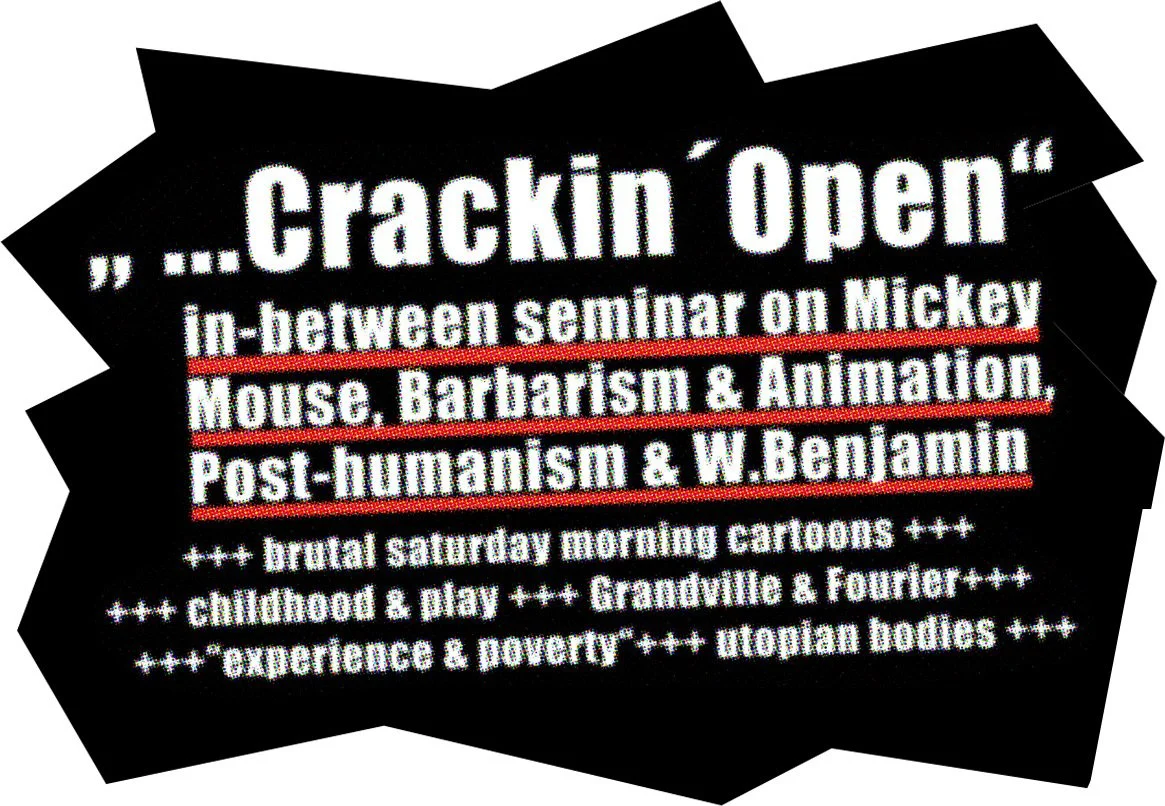
Drawing back on Walter Benjamin´s mysterious and exhilarating take on Mickey Mouse, the workshop explored post-humanist readings of early modern cartoons and their child-like anarchy. Staging the world as a place of playful chaos, early mickey mouse cartoons picture a cosmos in which no-one can quite tell who ´s moving what and what´s moving whom.
If “everything alive” is arguably moving, not everything moving is arguably alive. Celebrating the living universe, we went on to ask with Benjamin: what kind of life do we see in things, and what do they move in us as we attempt to animate them? Participants explored their own sense of entangled agency with the world, engaging with Benjamin´s fascinations for child-like percpetions to unlock their own creatures. Finally, Looking back at these early modern animation films and their celebration of "crazy motions", participants designed their own post-human cartoon character.

“Planetary gore”
This seminar took the dystopian visual language developing around the climate catastrophe as a departure point. the threat of an impeding ecological collapse and its speculated impact on social systems around the world generated a cluster of images and narratives haunting tv serials, artworks, novels and social media feeds. Between morbid voyeurism and anxiety management, How much do they tell us about ourselves? What can we learn about these tropes and what do they reveal about the ambiant values of late capitalism in the global north? The seminar proposed to engage critically with dystopian imageries and "collapse porn" narratives to develop new visions out of the bits and pieces thus deconstructed.
“Fiction fan”
Every piece of content released by the entertainment industry potentially becomes part of someone's reality, sometimes fanatically so. Music, Games, Novels or Movies are produced and experienced as prismatic meaning-making engines and socio-cultural magnets attracting adoring fans of all size and shape, could they be niche audiences or immense crowds. In the digital age, Fans are no common "creative audience". Some may still scarify their life ( or someone else’s) for what they love, but they’re soo longer sitting for creators to deliver. Contemporary Fans challenge intellectual property rights and established authorship to generate and share their own material, exploring new dimensions of collaborative authorship rapidly changing the mainstream. Passionately loving and hating their object of fascination, those who stalked creators and lived to the pace of new releases, now fill the gaps with their own creative contributions, expanding or “correcting” their beloved fictional worlds with all sorts of media materials. Reflecting on this phenomena, Bachelor students orf GWK share what they love, mix it up, invent their own franchise and generate their own participatory fan base.They reflected in the process on “fan fictional”practices by making themselves “fictional fans”. In collaboration with tov Spiekermann & the medienlabor ( 2021).
“Re-”
For those who grew up in the 80´s mainstream pop culture, the contemporary entertainment landscape may feel at times like a continuous déja-vu. Never ending Franchises, expanded universes and Spinoffs seem to repeat tried and true formulas until complete exhaustion. Is there more to it? A closer examination of the Reboot strategy serving mass entertainment´ s business models may however yield some interesting perspectives on societal changes. Spanning over decades, some of these “properties” can be explored as markers of cultural change. Using a beloved eighties classic (the kids classic “Goonies”) , the GWK class of 2022 challenged the originals drift and some of its problematic tropes to generate a wealth of spinoffs, alternate versions, fan fictions, remixes and imaginary essays squeezing everything this classic could tell us about the current cultural moment.
In collaboration with tov Spiekermann & the medienlabor (2022).
“Poliscyti”
At the end of the last decade, an unprecedented wave of protests manifested a widespread readiness to embrace the socio-ecological transition. Still, transforming our societies to face the climate crisis brings about extraordinary social and economic challenges. If technological “solutions” designed to deploy mitigation and adaptation strategies seem ready to roll out, their coordinated political implementation is failing - and this, despite the SDGs. While global action remains hampered by geopolitical tensions, the city scale provides different governing tools to implement local solutions and make them work for all. As experiments around the world have shown, transforming cities in an inclusive manner is possible, - but it remains a democratic challenge and an administrative headache. Transforming at scale demands strong policies, and these need difficult communication processes to unfold. How can design help? This research seminar explores how communication strategies, narrative prototyping and creative design interventions can provide new tools to participate in the public policymaking processes and help transform our shared urban environment. With visiting contributions of Dr. Steffen Lorey and Dr. Sopia Becker.
“Metamedia”
Where does this feeling come from?
“U-turn 1 & 2”
Growing up in the mainstream pop culture of the eighties, the current landscape of mass entertainment may feel at times like a continuous déja-vu. Never ending Franchises, expanded universes and Spinoffs seem to repeat tried and true formulas until complete exhaustion. A closer examination of the Reboot strategy serving entertainment´s industrial model may yield some interesting pers
“wording the world”
Growing up in the mainstream pop culture of the eighties, the current landscape of mass entertainment may feel at times like a continuous déja-vu. Never ending Franchises, expanded universes and Spinoffs seem to repeat tried and true formulas until complete exhaustion. A closer examination of the Reboot strategy serving entertainment´s industrial model may yield some interesting pers